
The previous blog introduced the concept of computational thinking (CT). To guide students on an upward trajectory from here, is to explore the wonderful mysterious world of robotics in the classroom. Simultaneously, robotics can add valuable teaching and learning strategies whilst instilling the power of their own creativity as well as enhance their CT skills.
Robotics will not be defined as a machine one can use due to a pre-programmed functionality, on the contrary, it is a machine one can control with the potential to foster their creativity by presenting an avenue to explore curiously.
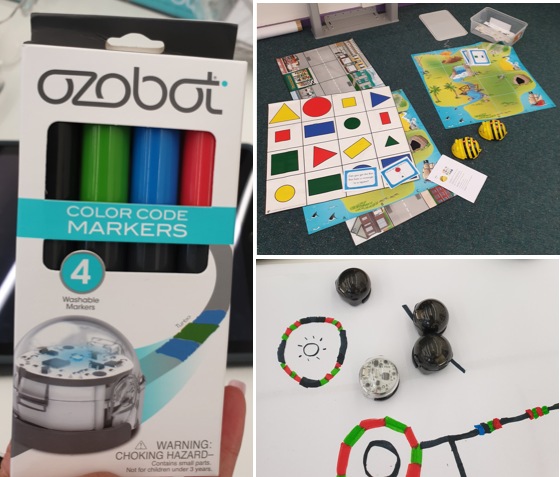
Robotics will not be defined as a machine one can use due to a pre-programmed functionality, on the contrary, it is a machine one can control with the potential to foster their creativity by presenting an avenue to explore curiously.
James from Mount View Elementary School claims that using Scratch “builds critical thinking and problem solving” which can then be applied to other KLA areas within the classroom. Due to the exposure the students had to Scratch, he saw his students class scores increase by thirty percent. James’ comment is strongly in line with Khanlari’s (2016) study of teachers’ perceptions on incorporating robotics into the classroom where teachers reported its benefits through improvements observed regarding student collaboration and teamwork, communication skills (sharing and presenting ideas), mathematical reasoning, problem-solving skills and scientific inquiry.
As discussed within the CT Blog, Scratch allows students the opportunity to create however they command to. Resnick (2014) presents the concept of ‘rapid prototyping’ where students are able to build and create ideas and learn off the back of them supports the concept of constructionism. Additionally, it has the capability to share with friends who can try their peer’s creation and send back useful feedback.
Considering the aforementioned ‘upward trajectory’, students can be introduced to Dash & Dot (D&D). Similarly to Scratch, Blocky is the application used to program D&D allowing students to apply their knowledge to a variety of platforms. Research mostly correlates CT and programming skills with integration in KLA areas such as science and math (Shute, San & Asbell-Clarke, 2017; Khanlari, 2016; Kim, Kim & Kim, 2013). Conversely, Jung & Won (2018) “social robots engage young children in learning different subjects through their social interaction with robots (p.2).” D&D integrate both these KLA areas, as well as English KLA areas. This is due to the unique capability of D&D’s programable audio dialogue. Consequently, students can create a story through CT, programming and creative writing. In addition to bringing stories to life, teachers benefit using an inclusive approach to assessment in cases where students are not comfortable standing in front of the class to present. Could it then be possible for D&D to deliver the students speech for them?
References
Code.org (2013, February 26). “Code Stars” – short film. Retrieved from https://www.youtube.com/watch?time_continue=414&v=dU1xS07N-FA
Jung, S.E. & Won, E. (2018). Systematics review of research trends in robotics education for young children. Sustainability, 10(4), 905
Khanlari, A. (2016). Teachers’ perceptions of the benefits and the challenges of integrating educational robots into primary/elementary curricula. European Journal of Engineering Education, 41(3), 320-330
Kim, B., Kim, T. & Kim J. (2013). Paper-and-Pencil programming strategy towards Computational Thinking for Non-Majors: Design Your Solution. Journal ofEducational Computing Research,49(4), 437-459
Resnick, M. (2014, March 13). Rethinking learning in the digital age – Mitchel Resnick [Video File]. Retrieved from https://www.youtube.com/watch?v=Ok6LbV6bqaE
Shute, V.J., Sun, C. & Asbell-Clarke, J. (2017). Demystifying computational thinking. Education Research Review, 22, 142-158
Texas State Library and Archives Commission (2017). Technology tools in action [Photograph]. Flickr. Retrieved from https://www.flickr.com/photos/tslac/38049098094/in/photostream/
 Digital Creativity and Teaching ;)
Leave a comment