
No Fear + More Risk = Solutions Creation
The Australian Curriculum, Assessment and Reporting Authority (https://www.australiancurriculum.edu.au/f-10-curriculum/technologies/key-ideas/) consistent with Shute, Sun & Asbell-Clarke (2017) define computational thinking (CT) as “a problem-solving method” supported by acquiring the skills to solve problems with or without the use of technology.
Misconceptions that CT skills can only be delivered through and are relevant to digital technology exist. Deconstructing a problem to solve using CT ensures skills attained are transferable across KLA areas. It is, however, achievable using the “paper-and-pencil programming strategy (Kim, Kim & Kim, 2013)” to teach CT.
The following six components (Shute et al., 2017) are critical skills in order to build computational thinking skills both without and in the presence of technology.
- Decomposition: students learn to systematically divide a problem into “manageable parts (Shute et al., 2017, p.153);”
- Abstraction: process of removing irrelevant information/data revealing main ideas or patterns;
- Algorithm: designing a set of instructions to be followed;
- Debugging: process of identifying errors and fixing them when the ‘program’ does not work as it should;
- Iteration: students loop back to the algorithm stage in order to rectify the error;
- Generalisation: The stage educators want to achieve in their students – learnt CT skills can be applied across KLA areas in order to solve problems
To make learning “meaning and motivating (Resnick, 2013)”, one can provide students the opportunity to create their own understanding, in turn building the skills required to build computational thinking competency. Students who are provided with time to ‘play’, don’t realise that it’s contributing to their problem-solving skills and therefore indirectly build a growth mindset.These attributes are critical to secure our students future lives. Teachers’ must equip students with critical attributes to secure their future, allowing students to use and understand technologies that don’t exist yet.
Students Create Their Own Understanding
CS Unplugged, Scratch or even Scratch to code a microbit all contribute to building CT skills. The below images demonstrate a microbit coded to verse the computer program in a game of scissors, paper, rock.
There are many ways to have students involved in computational thinking. These include, using CS Unplugged, Scratch or even Scratch to code a microbit. The below images demonstrate a microbit coded to verse the computer program in a game of scissors, paper, rock.
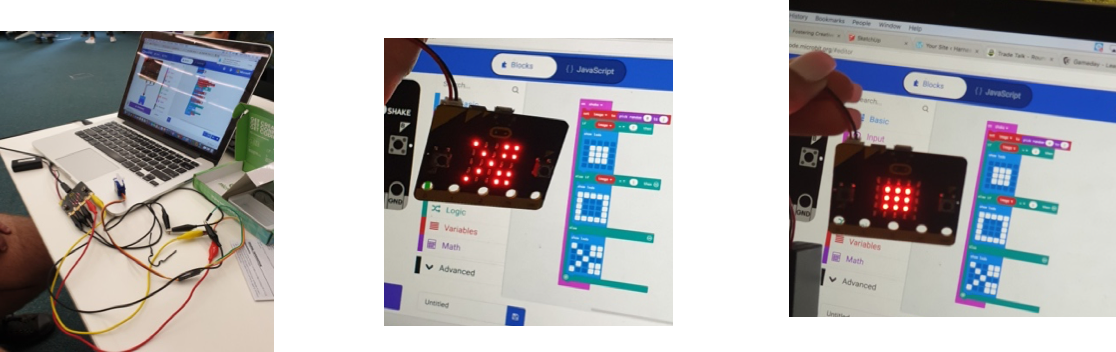
This engaging activity allowed the participants to practice the algorithm and debugging components to reap the rewards of their efforts. It is suggested by Kim, Kim & Kim (2013) that students gain more from learning computational thinking without a computer. Enter CS Unplugged (https://csunplugged.org/en/topics/kidbots/unit-plan/fitness-unplugged/), a strategy eliminating digital technologies as suggested by Kim, Kim & Kim (2013). This unit incorporates computational thinking with PDHPE, which can be further developed using Scratch Programming as shown below.
References
Kim, B., Kim, T. & Kim J. (2013). Paper-and-Pencil programming strategy towards Computational Thinking for Non-Majors: Design Your Solution. Journal of Educational Computing Research,49(4), 437-459
Resnick, M. (2013, January 29). Mitch Resnick: Let’s teach kids to code [Video File]. Retrieved from https://www.youtube.com/watch?v=Ok6LbV6bqaE
Shute, V.J., Sun, C. & Asbell-Clarke, J. (2017). Demystifying computational thinking. Education Research Review, 22, 142-158
 Digital Creativity and Teaching ;)
Leave a comment